Do You Need Math to Make Games in Unity?
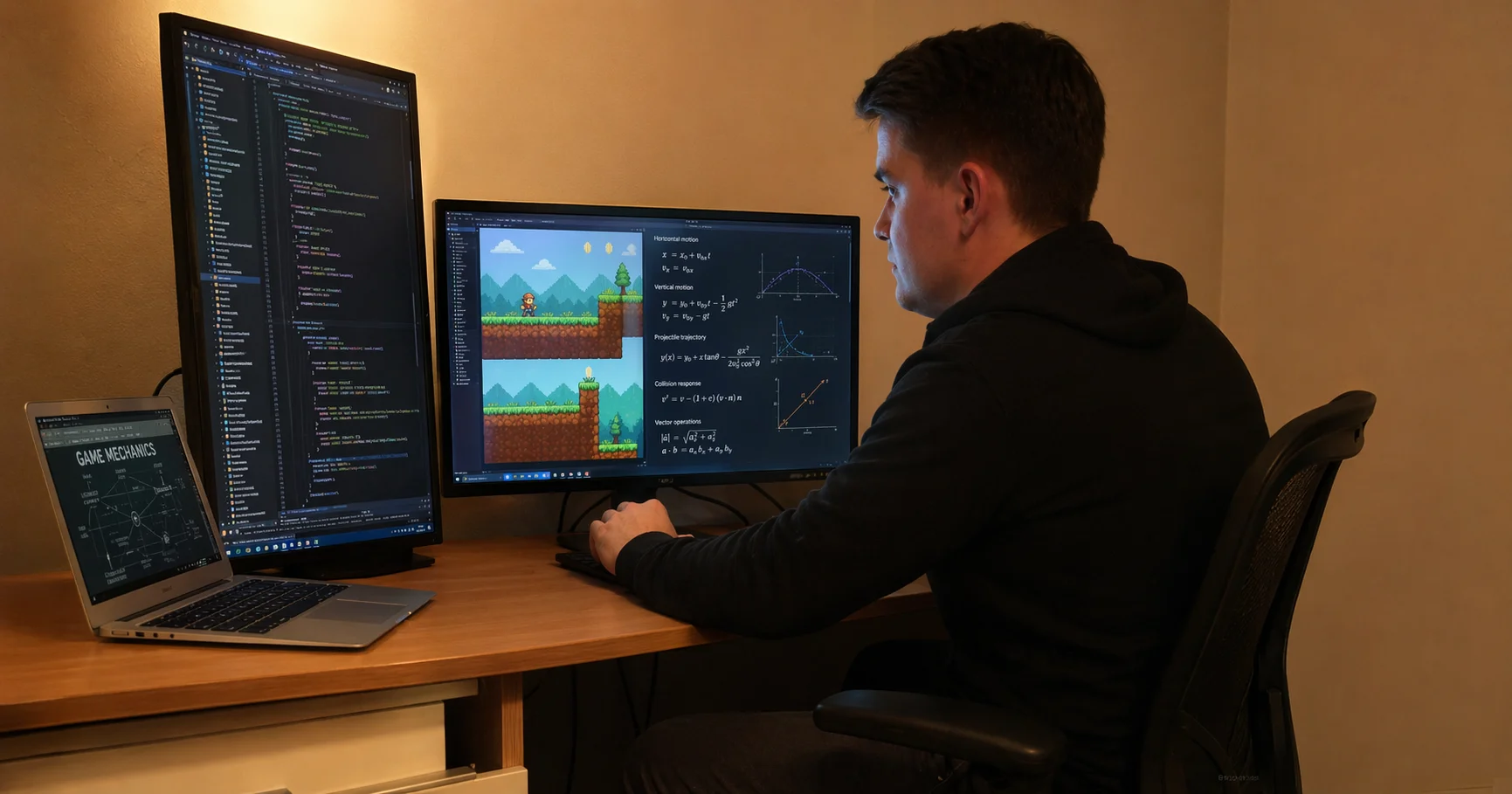
TL;DR
The "you don't need math for game development" advice is half true. It holds for casual hobbyists, and it falls apart the moment you treat Unity as a career. Math is the tool that closes the gap between what the engine ships and what a real project asks for, it is what unlocks one-line solutions to problems that look hard, and it is what keeps you useful as AI starts replacing tutorial-only developers. Beginners should start on day one with vectors and normalization and keep going from there.
This is a dilemma as old as Unity and game development in general. On forums, the most common advice is that you do not need math for game development, and I disagree. That advice usually comes from two kinds of developers. The first is the casual hobbyist who only builds small games, and for them it happens to be true. The second is the experienced developer who absorbed so much math over the years that they stopped noticing it.
The second group is the one to be careful with. People who say math does not matter in game development are like rich people saying money does not matter, they already have it, so they have forgotten what it is like to live without it. If your goal is to make game development your career, the honest answer is yes, you need to learn math.
Why you need math for game development
If you are making games like everybody else, a character running around and jumping through simple interactions, you will be mostly fine. Standard Unity components cover it. The math lives inside them, and you can go a long time without touching it directly.
That is the casual path, and there is nothing wrong with it. But I am a professional freelancer, and a freelancer does not get to tell a client "that cannot be done." When the job lands on your desk, either you figure it out or you lose the project. I had one of those moments almost 10 years ago.
We were building an AR app where the user would trace the outline of their floor with a finger, and the app would replace it with a custom tile texture, so they could see what new tiles would look like in their actual room before installing them. This was before modern AR tools handled ground detection cleanly, and before you could prompt an AI to write a helper shader. You either understood the math, or you were stuck.
Here is what the feature actually demanded. The user traced the floor outline by touching the screen. Each touch was a 2D point, and we had to convert it to a 3D point on the detected plane through ray-plane intersection. That is vector math. Those points formed a polygon, and from the polygon we built a visible mesh: vertices, triangles, normals, UVs. None of that ships with Unity, you write it yourself. Then came the shader. The floor needed tiles with grout, the thin joints between them, at a realistic width no matter how big the room was. We did that with world-space UVs, modulo for repetition, and smoothstep for the grout edges.
That was the moment I realized how important math actually is, and that I was not going further in this career without it. I sat down and learned what the project demanded. Back then there was no tutorial for any of this, no article, no Reddit post. You were on your own.
What math unlocks
Once you understand a handful of math building blocks, a surprising number of "how do I do this in Unity" questions collapse into one line of code.
Here is a story from Skeletons AR, one of my AR projects. The game had grenade throws, and the obvious path was Unity's built-in physics: add a rigidbody, set the initial velocity, let gravity handle the arc. That works fine in a regular 3D game where you control the world. In AR it does not, because you do not control the world. The player holds the phone however they want, and if they tilt it, AR's idea of "down" drifts off the real floor. Suddenly your grenade curves sideways instead of landing where the player aimed. A few devs told me to lean into physics harder and compensate. I went the other way. I threw physics out entirely and hand-rolled the arc with a quadratic Bezier curve.
A quadratic Bezier uses three control points: the throw origin, a peak in the air, and the landing target. One formula interpolates between them as time moves from 0 to 1. (1-t)²P0 + 2(1-t)tP1 + t²P2. One formula, one line of code, no physics engine, no gravity vector to worry about, no dependence on how the player held the phone. The grenade left the hand, followed a clean predictable arc, and landed exactly where the player aimed, every single throw.
Other building blocks behave the same way. The dot product tells you how much two vectors point the same direction, which collapses "is the enemy in front of me, can the AI see the player, am I looking at the door" into one line each. Linear interpolation (lerp) is how you stop writing jittery code and start writing smooth camera follows, fade transitions, and spring damping. Basic trigonometry lets you oscillate, spiral, or wave anything without needing a new asset.
You stop writing a hundred lines to brute-force a problem and start writing one line that actually describes the problem. The code does not just shrink. It starts to feel less like duct tape and more like a design.
Why the "you don't need math" advice is a trap
What I am going to say next is going to offend many. If you are a game developer and you do not know game math, you are not a real developer. Yes, that includes even if you made money with your game. Many will comment on this, "but I made a product that sells," and great for you, I am happy for you. That still does not make you a real developer or engineer. This article is about math, it is not about making money. It is like saying Jeff Bezos is better at math than Alan Turing because he is richer. It does not make sense.
At a job interview, you will likely be asked a math question, and if you want to increase your chances of passing the interview, learn math. That is the best advice I can give you.
Should beginners learn math in Unity?
Yes, they should, and there are many benefits to starting from day one. The formulas are simple, and most of them show up in the code a beginner is already writing.
Take basic movement. A beginner is going to build a character that walks around almost immediately. The formula behind that is a direction vector multiplied by a speed and added to the position every frame. transform.position += direction * speed * Time.deltaTime. That one line is a direct reading of vector addition and scalar multiplication. If you understand what each piece of that expression does, you have already absorbed two of the most important pieces of game math for free, just by building your first character controller.
The second piece comes the moment you let the player change direction with keyboard input. Your input gives you a raw direction vector, and if the player presses two keys at once, say up and right, that vector's length goes over 1, which makes diagonal movement faster than walking straight. The fix is normalization, which scales any vector down to length 1 while keeping its direction. One line, direction.normalized * speed, and the diagonal bug is gone. That is the beginner's first real encounter with unit vectors, and it sticks because the bug is visible on screen.
Those two ideas alone, vector addition and normalization, already carry a beginner through most of what they will do in their first few Unity projects. There is no reason to defer them. Learn them while you are learning movement, and the math stops being scary before it gets a chance to become scary.
Final thoughts
If you take only one thing from this article, take this. The "you do not need math for game development" advice is half true, and the half that is false is the half that decides your career. Hobbyists can skate. Professional Unity developers cannot.
Math is the tool that closes the gap between what Unity ships and what a real project actually asks for. It is what let me build a custom floor shader for an AR app, and it is why I reached for a Bezier curve instead of Unity's physics when the physics would have betrayed me. It is also what collapses long branching code into one line that actually describes the problem.
If you are a beginner, do not defer it. Start with vectors and normalization on day one, while you are building your first character controller. The math you skip now becomes the bug you cannot fix later, and AI tools are about to make tutorial-only developers look very replaceable. Learn the math. You will not regret it.
