Why "Learn C# First" Is Bad Advice for Unity Beginners
TL;DR
If you are new to Unity, do not learn C# first and do not learn Unity first either. Learn them together by picking a small game, finishing it, and picking up only the C# and Unity concepts the project forces on you. Pong is the ideal first project. C# alone is boring and will quietly kill your motivation before you ever build anything real. Unity alone leaves you dependent on the Asset Store and stuck the moment you need custom code. The combined path keeps you moving, keeps you motivated, and turns you into an actual Unity developer instead of someone who can only click buttons in the editor.
If you are starting out in Unity game development, you have probably asked yourself: should I learn C# first, or jump straight into Unity? Most advice online says "learn C# first." That advice is not wrong, but it is not optimal either.
I learned Unity first. For a long time I leaned on the editor and the built-in tools, which in 3D can carry you surprisingly far. I once built enemy AI using Unity's NavMesh system and felt like a real game developer. It worked, it looked good, and I was proud of it. Then I tried to do the same thing in a 2D side-scroller, and the whole illusion cracked. There is no NavMesh for 2D out of the box. You have to write a custom pathfinding solution yourself, and I could not, because I did not know C#. That was the moment I understood what "Unity developer" actually means. The editor is a fantastic starting point, but the minute you step outside of what Unity hands you for free, you need to program. No tool covers every case in your game.
So I get the instinct behind "learn C# first." It fixes the exact gap that caught me. But after eleven years in Unity, I can tell you there is a better path: learn them together. Unity without C# is a dead end. C# on its own is slow and, honestly, boring. You are not building anything fun. You are reading about variables, loops, and classes in a console window, and if you are new to programming and the type who gives up easily, that grind will quietly kill your motivation. Combine C# with Unity and the whole thing changes. You are making a game and learning programming at the same time. The reward loop is immediate, which is the difference between the people who last and the people who quit. Learning C# all the way through before opening Unity is technically the cleanest order, but the real question is: will you still be there when you finish? I recommend Unity and C# together. (I also walked through this argument in a short video on YouTube if you prefer that format.) This article is for two kinds of readers: total beginners who have not picked a path yet, and people already halfway in, wondering if they picked the wrong one. You did not. But you can still do it better.
Table of contents
- Why Learning Unity Without C# Hits a Wall
- Why Unity-First Games All Look the Same
- Why Learning C# First Kills Your Motivation
- When Learning C# First Actually Works
- Why Unity and C# Together Is the Path That Actually Works
- The Pong Test: Your First Unity + C# Project
- So, Should You Learn C# First or Unity First?
Why Learning Unity Without C# Hits a Wall
Most Unity beginners do not pick Unity because they love programming. They pick it because they have a dream game they have carried around since childhood, they type "how to make a game" into Google, and Unity is one of the first results. So the motivation is the game, not the language. You follow a tutorial, you drop a character controller into the scene, you hit play, your character moves, and suddenly you are building something. For a while it feels like real progress. You lean on built-in components, Asset Store packs, and whatever the tutorial told you to click. And then, at some point, you hit a wall.
The wall is not usually dramatic. It shows up the moment you want to do something the engine does not hand you. You want a mechanic you have not seen in a tutorial. You want to tweak an asset you paid for but the creator locked the code. You want to make two systems talk in a way the inspector cannot express. Without C# you stall, and if you cannot program, you do one of two things: you give up on the idea, or you swap it for something else a tutorial already covers. Either way, your actual game gets further away, not closer.
Why Unity-First Games All Look the Same
The deeper problem is dependence. Unity's built-in tools and the Asset Store are genuinely excellent. The engine in 2026 is not the same engine I started with in 2015, it is far better, and the Asset Store has packs that would have saved me serious time back then. I am not telling you to avoid any of it. I am telling you that if you cannot write code, the tools use you instead of the other way around. You cannot extend them. You cannot fix them when they do not quite fit. And your game ends up looking and feeling like every other beginner game shipped that year, because everyone shopping at the same store with the same templates produces the same result. The thing that makes a game stand out is almost always the part somebody had to write themselves.
This is the trap I walked into, and it cost me real time. I wrote about it in How I Learned Unity the Wrong Way, if you want the long version. The short version is the reason for this article: do not learn Unity first. But do not learn C# first either. Learn them together, and when you are inside the editor, reframe what you are doing. You are not "learning Unity." You are learning C# to build games in Unity. That small shift changes what you focus on, what tutorials you pick, and what you are willing to sit through when something is boring. The editor becomes a tool, not a cage.
Why Learning C# First Kills Your Motivation
Learning C# first is super boring. If you are not one of those quiet, patient types like John from Silicon Valley, the guy who could happily sit in a server room reading documentation for hours, it is going to drain you. He is my favorite character in the show, do not get me wrong, but he is also the exact type of person you need to be to enjoy going C# first. If you are not that type, C# first is going to feel like a slow leak.

When you learn C# before touching Unity, you open a terminal, you write Console.WriteLine, and you build calculator killer apps that nobody asked for. You make a CLI that prints a menu, accepts numbers, and returns the sum. Then one that reads a file. Then one that sorts it. None of it is meaningful. None of it is yours. You are solving textbook problems in a black window, and if you came here because you wanted to build the game you have had in your head since you were a kid, every hour you spend in that terminal is an hour that game does not exist yet.
When Learning C# First Actually Works
I want to be clear: I have nothing against learning C# before Unity. In terms of pure technical order, it is probably the most optimal way to do it. You would have a cleaner foundation, you would understand the engine faster when you finally open it, and you would skip a lot of "why does this not work" frustration. The problem is not correctness. The problem is motivation. Is it more fun to build a Space Invaders clone as your first C# and Unity project, or a terminal app for accountants? Learning to program is already difficult. There is no reason to make it harder by stripping out the one thing that made you want to start in the first place.
There are two exceptions to this. If you are already a .NET developer switching into game dev, you already speak C#. Your bottleneck is Unity, not the language, and this whole debate is irrelevant to you. Open Unity, port what you know, and go. The second exception is someone who just came out of a computer science degree where C# was part of the curriculum. You are not learning it from scratch, you are applying it, and the motivation problem does not apply because you already did that phase inside a school with deadlines and classmates. For everyone else, including me when I started, C# first on your own, at home, unassisted, is a motivation killer. This is my personal opinion. You can still go that way if you want. It is your time.
Why Unity and C# Together Is the Path That Actually Works
This is the best way by far to learn Unity. Not slightly better. By far. Pick a small game, commit to finishing it, and learn every C# concept the project demands as it demands it. You are not "studying" C#. You are using it to build something you can play at the end. That changes the entire experience. If you are not sure what counts as "small," I covered that in How to Actually Learn Unity in 2026 in the Age of AI. The short version is: smaller than you think.
Your goal here is not to master C#. Your goal is to ship a tiny game while picking up the C# fundamentals that the tiny game needs. For a first project you only need a few things: primitive data types, conditionals, and arrays. That is it. You do not need delegates, events, LINQ, generics, async, or any other advanced topic. Those come later, naturally, when a bigger project forces them on you. On the Unity side, you only need the basics of the old input system. Do not jump into the new Input System yet, even though it is the recommended one going forward. It relies on C# events and action maps, which are too much for a beginner who has not yet understood what an event is. Start simple, swap later.
The Pong Test: Your First Unity + C# Project
Here is a concrete example. The game I always recommend as a first project is Pong. Two paddles, one ball, two walls. That is the whole thing, and it forces you to learn exactly the right slice of Unity and C# to be dangerous. You press a button and the paddle moves up or down, which means you have to learn the Input class. To move the ball every frame you need the Transform component and the Vector3 type. When the ball hits a wall or a paddle it bounces, which introduces you to collision events in Unity. That is a complete, shippable game, and you have quietly learned the core Unity concepts without ever opening a generic "C# for beginners" tutorial.
The principle behind all of this is called KISS. It is an old one in programming: Keep It Stupid Simple. Your first game should be stupid simple. Your first scripts should be stupid simple. If something feels complicated, it almost always means you have bitten off more than you needed to. Cut the scope. Cut the features. Ship the smallest thing that works, then add on top of it. You will learn more from finishing one tiny game than from starting ten ambitious ones.
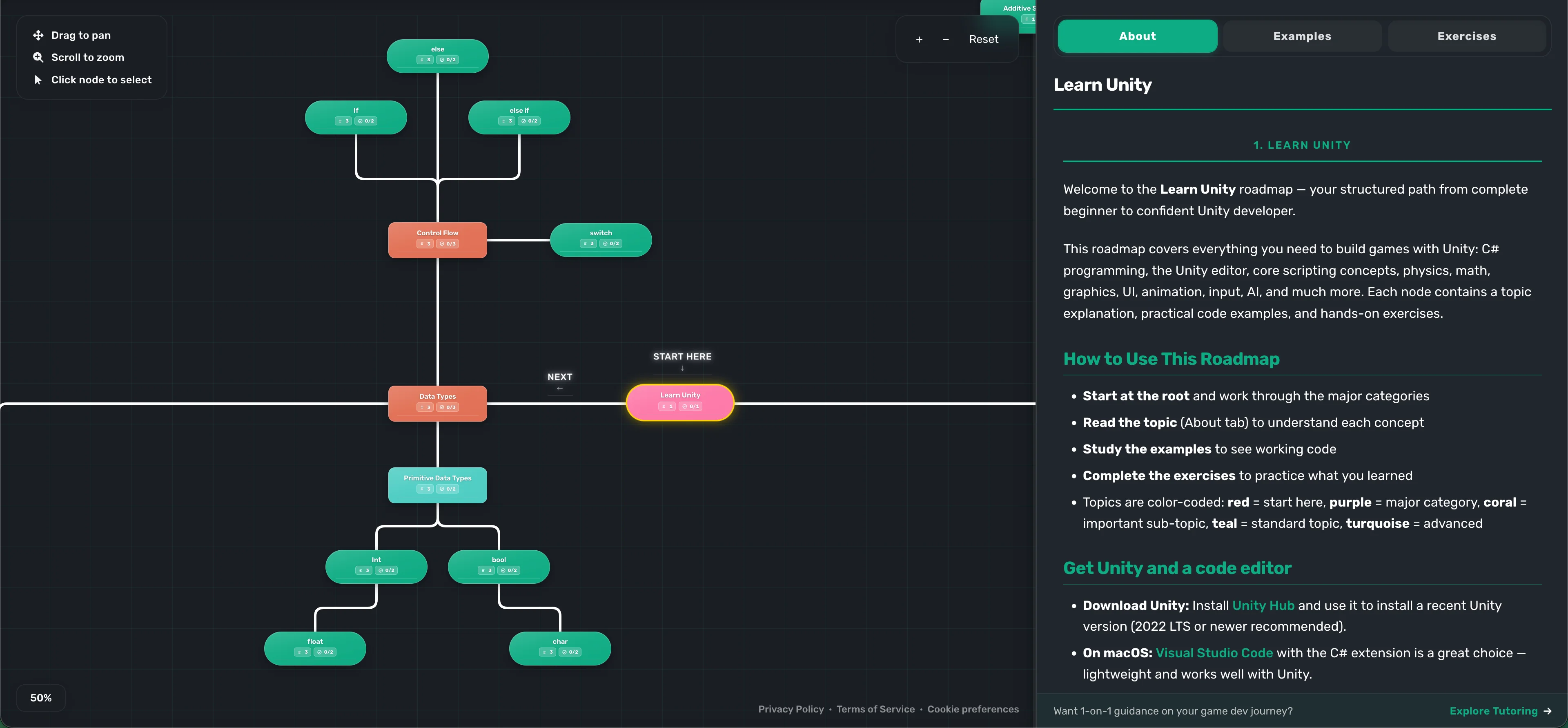
If you want a structured path that follows this same logic, I built one. It is called the Learn Unity Roadmap, and it is completely free. It is a node-based map where each topic links to the next in the order I wish someone had given me when I started. C# concepts and Unity concepts sit side by side, exactly the way you should be learning them. No courses to buy, no login wall, no email gate. Just the path.
So, Should You Learn C# First or Unity First?
Neither, and that is the whole point of this article. The honest answer after eleven years in Unity is that you should learn C# and Unity together, at the same time, on the same project. Not C# for a month, then Unity. Not Unity for a month, then C#. Both at once, starting on day one. Pick a small game, open Unity, and learn each C# concept the project forces on you as it comes up. The engine and the language are not two separate skills you grind in sequence. They are one skill, and the fastest way to build it is to build a tiny game while you are still figuring out what a variable is. Stop debating the order. Learn them together and start building. If the solo grind still feels slow after a few weeks, that is when a tutor earns their fee. Read what to ask a Unity tutor before you hire one so you pay for someone who has actually walked this path.
